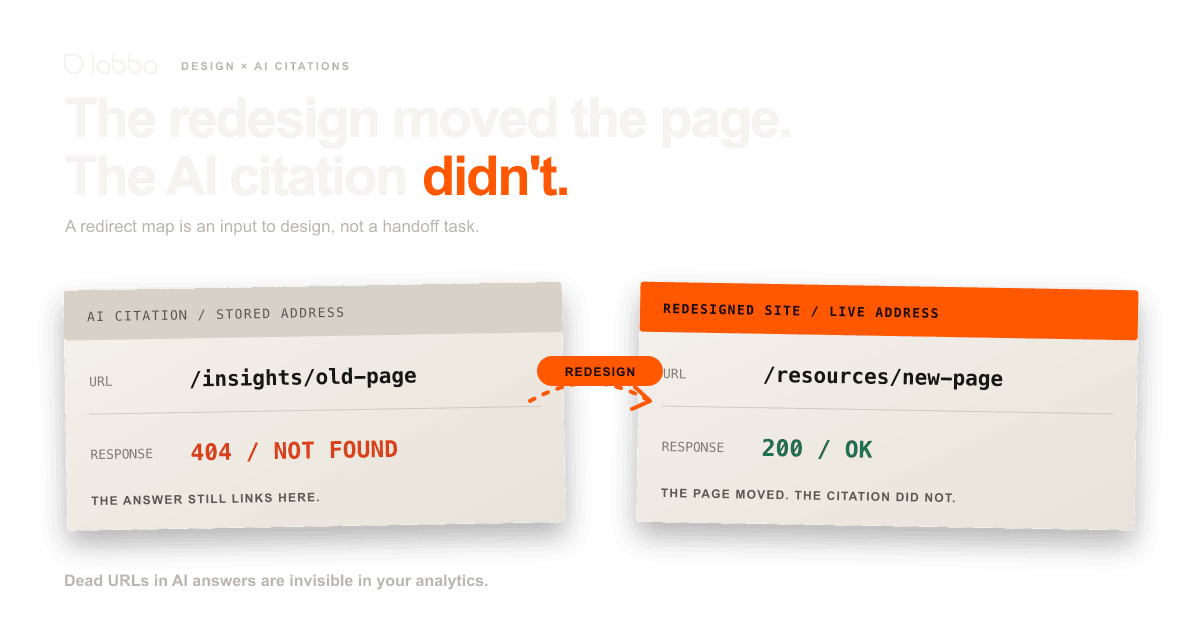
A redesign almost always changes URLs. That used to be a search problem with a known fix: permanent redirects, a few weeks of turbulence, rankings settle. It is now also a citation problem. AI assistants answer questions by citing specific URLs, and Ahrefs, measuring 16 million cited URLs in a study published on 2 September 2025, found that 2.38% of the URLs ChatGPT cites return a 404, the code a server sends when the page is not there, against 0.84% for Google's own results. Some of those dead URLs belong to pages that sites have already retired.
What that changes for anyone planning a rebuild is the order of operations. A redirect map — the list that says which old URL now points where — is normally produced during the developer handoff, after the sitemap, the templates and the navigation are settled. Our position is that this is backwards, and that the map belongs at the start of the project, because the cost of getting it wrong has moved somewhere your analytics will not show you.
URLs don't break. People break them.
Tim Berners-Lee made the argument in 1998 and it has not needed revising: "URIs don't change: people change them." In Cool URIs don't change he points out that there is no technical force pulling addresses apart — "there are no reasons at all in theory for people to change URIs (or stop maintaining documents), but millions of reasons in practice". The reasons are organisational. A company reorganises, a CMS is replaced, someone decides that /solutions is a better word than /services, and a few thousand addresses move.
The accumulated result is link rot, the term for web addresses that once resolved and no longer do. The Pew Research Center measured it in a study published on 17 May 2024, testing around a million pages drawn from Common Crawl archives between 2013 and 2023: 38% of the webpages that existed in 2013 were no longer accessible by October 2023, and 25% of all the pages collected across that whole decade were gone. Not gone as in badly ranked. Gone as in the address returns nothing.
Link rot is usually discussed as something that happens to other people's links. Pew found that 54% of Wikipedia pages contain at least one reference pointing to a page that no longer exists — and every one of those broken references is a site that restructured its URLs and moved on.
What an AI assistant does with a page that moved
Search engines and AI assistants both point at URLs, but they fail differently when one disappears. Google demotes the address and eventually drops it. An assistant writes it into an answer, and the reader clicks a link that goes nowhere.
The Ahrefs study, by Ryan Law and Xibeijia Guan, is the largest measurement of this available. Across all cited URLs, ChatGPT's 404 rate was 2.38%, Perplexity's 0.87%, Gemini's 0.86% and Copilot's 0.54%, with Google's results at 0.84% as the baseline. Measured differently — only URLs a real person actually clicked — ChatGPT came in at 1.01% and Google at 0.15%. Overall, the authors found that "AI assistants send visitors to 404 pages 2.87x more often than Google Search".
Two things cause that, and the study names both without splitting them numerically. One is genuine invention: a plausible-looking address that never existed. The other is the one that concerns anybody about to rebuild a site — pages that "may have existed at one time, but have since been deleted or moved (without redirecting the original page)". The Tow Center for Digital Journalism ran 1,600 queries across eight tools in a study published on 6 March 2025 and found that more than half of the responses from Gemini and Grok 3 cited fabricated or broken URLs leading to error pages.
Our read of those numbers — and this is inference, not something any of the sources states — is that a URL change works its way through AI citation sets more slowly than it works its way through a search index. Nobody has published how long an assistant holds an address it learned six months ago, and nothing here says the engines fail to follow redirects. What is measured is narrower and still uncomfortable: the addresses in circulation inside AI answers are, on average, older and deader than the ones in Google's results.
Google publishes a maintenance contract. No assistant does.
The asymmetry that should worry you is not about quality, it is about knowing when you are safe. Google's documentation on moving a site with URL changes is specific. Use permanent redirects — the kind that tell any client a page has moved for good — "such as 301 and 308"; "keep the redirects for as long as possible, generally at least 1 year"; expect that "a small to medium-sized website can take a few weeks for most pages to move". That is a contract. You can plan a hosting bill and a decommissioning date around it.
There is no published equivalent from any generative engine. OpenAI documents which crawler does what — OAI-SearchBot "is used to surface websites in search results in ChatGPT's search features", and sites that opt out of it "will not be shown in ChatGPT search answers" — but says nothing about how long an address survives after it moves. In the absence of a number, the only defensible planning assumption is that redirects need to outlive Google's one-year floor, not match it.
A small illustration, verified while writing this on 11 August 2026: OpenAI's own crawler documentation used to sit at platform.openai.com/docs/bots and now returns a 301 to developers.openai.com/api/docs/bots. The company that publishes the crawler moved the page that describes it. Redirects are not an exotic failure mode reserved for careless teams — they are what happens to every site that stays alive long enough to be reorganised.
The pages worth saving are not the ones with the most traffic
Migration audits are almost always ranked by sessions. You export the top 200 pages, map those carefully, and let a script handle the tail. It is a reasonable heuristic for a world where the thing you are protecting is aggregate traffic.
It is the wrong heuristic for citations, and this is the part we would argue hardest. An assistant cites the page that answers one specific question well, and that page is frequently narrow and low-traffic: a changelog entry, a pricing FAQ, a post about a problem four hundred people a year have. Ranked by sessions it sits below the fold of the audit. Ranked by how often it is the best answer to something a real person types into a chat window, it may be the most valuable URL you own. Those are not the same list, and only one of them is in your analytics.
Which suggests a different sequence. Freeze the URL map before design starts. Decide which addresses are permanent and build the information architecture around them, rather than deriving addresses from whatever navigation the design lands on. Treat the redirect map as a content decision someone owns, not a spreadsheet a developer fills in during the last sprint. When we scope a rebuild, that is the order we argue for, and it is the one part of the process where being stubborn early is cheap.
None of this is a reason to avoid redesigning. Sites need rebuilding, and Berners-Lee's advice to design addresses that never need changing is easier to give than to follow. It is a reason to stop treating the URL as an output of the design and start treating it as an input — and to keep the redirects long after the point where Google says you can stop. We wrote separately about what actually gets you cited in the first place.
The thing to watch over the next few months is whether any of these engines starts publishing what Google publishes: how it treats a page that moved, and for how long. Until one of them does, the URL map is the part of a redesign you cannot undo.
Frequently asked questions
How long should I keep redirects after a redesign?
Google's documentation says to keep them "for as long as possible, generally at least 1 year". No AI assistant publishes a comparable figure, and the measured dead-URL rates in AI citations are higher than in search results, so one year is a floor rather than a target. Keeping a redirect costs almost nothing; discovering you needed it does not have a fix.
Do 301 redirects preserve AI citations the way they preserve search rankings?
Nobody has published an answer, and we will not invent one. What is documented is that Google treats a 301 as the correct signal for a moved page, and that assistants cite dead URLs at meaningfully higher rates than Google's results do. A redirect is clearly better than a 404 in either case; how completely it carries a citation across is unmeasured.
Does this mean I should never change my URL structure?
No. It means the change should be a deliberate decision with a named cost, made at the start of the project by whoever owns the content, rather than a side effect of a new navigation menu agreed in week six. Some restructures are worth it. Most of the ones that happen were never actually decided.
Sources
- Tim Berners-Lee, Cool URIs don't change — W3C, 1998.
- Athena Chapekis, Samuel Bestvater, Emma Remy and Gonzalo Rivero, When Online Content Disappears — Pew Research Center, 17 May 2024.
- Ryan Law and Xibeijia Guan, How Often Do AI Assistants Hallucinate Links? — Ahrefs, 2 September 2025.
- Klaudia Jaźwińska and Aisvarya Chandrasekar, We compared eight AI search engines. They're all bad at citing news. — Tow Center for Digital Journalism, 6 March 2025.
- Site move with URL changes — Google Search Central documentation, accessed 11 August 2026.
- Bots — OpenAI documentation, accessed 11 August 2026.