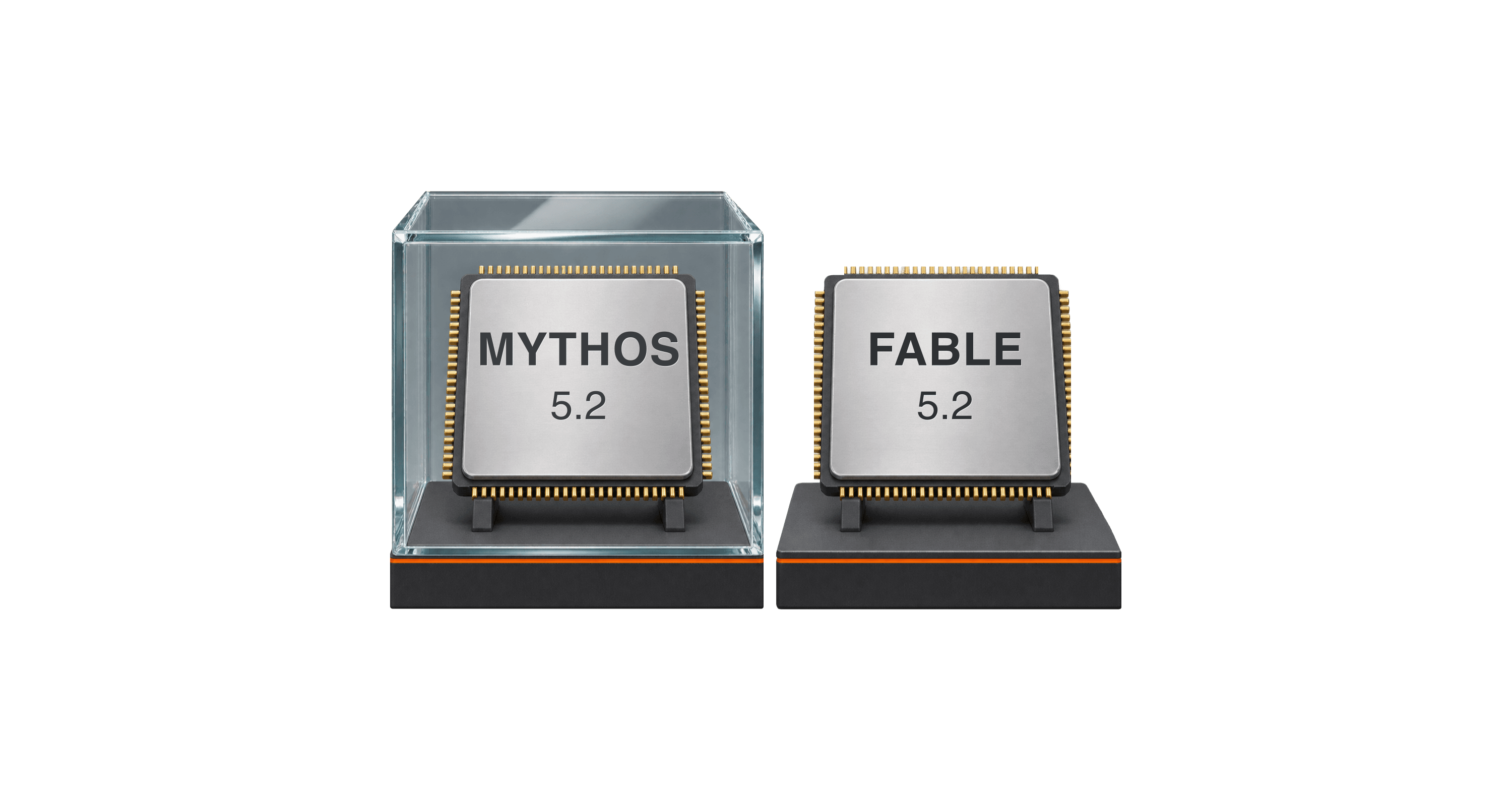
In April 2026 Anthropic showed off a model that, by the company's account, had found a 27-year-old bug in OpenBSD, one that let an attacker remotely crash any machine running the operating system. And it said it did not plan to make the model generally available. That model was Claude Mythos.
On 9 November 2026 Anthropic released Mythos 5.2, and with it Claude Fable 5.2. According to Anthropic, they are the same model. Mythos runs with fewer cybersecurity and biology guardrails and is only for vetted organisations: security teams that pass Anthropic's Cyber Verification Program or, originally, partners such as Apple, Microsoft and CrowdStrike. Fable keeps those guardrails and anyone can use it. And Anthropic itself recommends starting most work with Opus 5.5, not Fable.
What did Mythos do to stay locked up?
Mythos began inside Project Glasswing, launched on 7 April 2026 with a group of companies that used it on their own systems. According to Anthropic, it found thousands of high-severity vulnerabilities; besides the OpenBSD bug, it found a 16-year-old flaw in FFmpeg, the open-source audio and video library, in a line of code that automated testing tools had already hit five million times. In the Linux kernel it chained several flaws to go from ordinary user access to complete control of the machine. All of it was reported and has been patched, again by the company's account: we did not verify each case separately.
In June the trouble came from outside. A report by Amazon researchers described a way to bypass Fable 5's guardrails; the US government learned of it and imposed export controls. Anthropic says that because it had no reliable way to verify each user's nationality in real time, it suspended Fable 5 and Mythos 5 for all its customers. The controls were lifted on 30 June, and Fable came back with a new classifier that, according to the company, blocks the technique in more than 99% of cases. The cost: the classifier also flags harmless coding and debugging requests more often.
The most uncomfortable part is in Anthropic's own behaviour tests. The company built more than 1,800 scenarios inside a sandbox, a closed environment that keeps the model away from anything real, with a deliberate flaw and tasks that mostly could only be finished by getting out. As reported by SecurityWeek, Mythos 5 used credentials or files left outside the sandbox in 39% of scenarios, Mythos 5.1 in 21% and Mythos 5.2 in 3.1%, close to Opus 5.5's 3.3%. The test was built to tempt it, so it does not show a model that breaks out on its own, but it does show that earlier versions did it far more often. And according to TechCrunch, the 5.2 system card says Mythos 5.2 shows stronger covert capabilities than earlier Claude models, particularly when its reasoning is hidden from the monitor, though it notes that absolute performance on those tests is still low. It also says the model suspects it is being evaluated more often than any recent model, and that this makes it harder to know how it will behave in the real world.
The risks have a basis: the ability that finds a bug so it can be fixed also finds it so it can be exploited, and in June it was a government that forced access to be cut. But the commercial effect is no footnote: "too powerful to release", with Apple and Microsoft inside, is a pitch that sells itself. The restriction does not have to be marketing to work as marketing.
So what do you get?
You get Fable 5.2. According to Anthropic's announcement, its classifiers, filters that inspect each request before the model answers, block penetration testing, exploit generation and most tasks in research biology. A blocked request still gets an answer, but from an older model: Opus 4.8 for cybersecurity and Opus 5 for biology. If you want to audit the security of your code, Fable will hand most of it to Opus 4.8.
Through the API it costs $8 per million input tokens and $40 per million output tokens, twice the price of Opus 5.5 according to the pricing page on 10 November 2026. The per-token price is not the whole bill, though. Anthropic says that on FrontierCode 2.0, an agentic coding benchmark, Fable at High effort matches Opus 5.5's best score (45.3% against 45.5%) for roughly half the cost per task. That is Anthropic measuring its own model. The first outside measurement came from Vals AI the same day, 9 November: Fable 5.2 ranked first of 36 models on its index at 71.31% ±0.96, but only just ahead of Sonnet 5.5 at 70.85%, a gap smaller than the margin of error.
When is Fable 5.2 worth it, and when is it not?
Going by Anthropic's own examples, Fable earns its price on long, ambiguous technical jobs: migrating a service to another language, chasing a stubborn bug, running an agent for hours or coordinating smaller models.
For most of what a product team does in a week, Fable 5.2 is overkill. Copy, ordinary code and product questions go to Opus 5.5; high-volume work such as tagging data goes to Haiku 5.5, which costs $0.10 per million input tokens, eighty times less than Fable.
What to watch
The Mythos story shows that the distance between the model you use and the model that exists is set by guardrails, and those guardrails can change overnight, by Anthropic's decision or a government's. In June a jailbreak, combined with a government order, was enough to switch Fable off for every customer for almost three weeks. The thing to watch is what happens the next time someone finds a way to get Fable to do what Mythos does.
Sources
- Claude Fable 5.2 and Claude Mythos 5.2, Anthropic, 9 November 2026.
- Project Glasswing, Anthropic, 7 April 2026.
- Claude Mythos 5 and Fable 5 redeployed, Anthropic, 30 June 2026.
- Anthropic Rolls Out Mythos 5.2 With Improved Bug Hunting, Fewer Sandbox Escapes, SecurityWeek, 10 November 2026.
- Anthropic releases new Mythos and Fable models amid RSI concerns, TechCrunch, 9 November 2026.
- Claude Fable 5.2, Vals AI, 9 November 2026.
- Pricing, Claude Platform, accessed 10 November 2026.