
Publicado el 10 de noviembre de 2025. Actualizado el 5 de agosto de 2026 con datos nuevos.
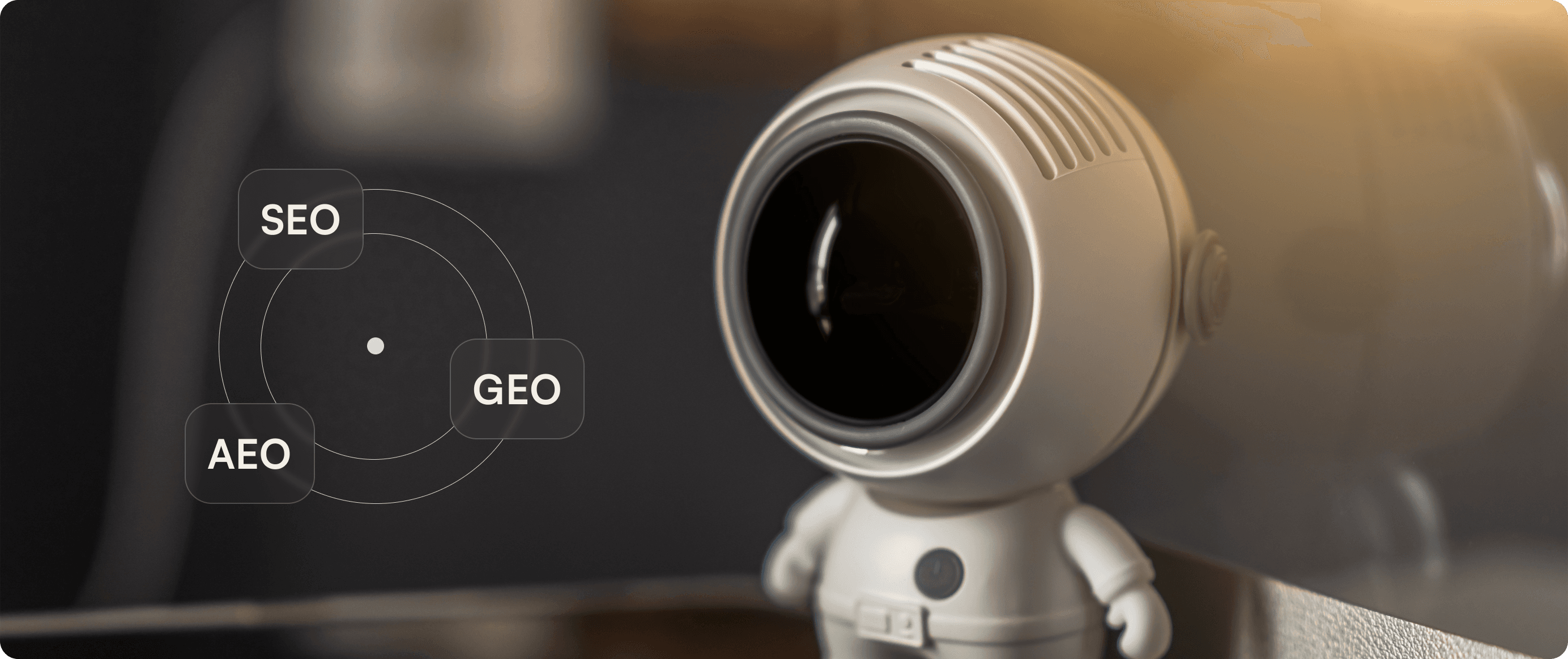
AEO (Answer Engine Optimization) is writing so an assistant can lift your answer directly. GEO (Generative Engine Optimization) is writing so a generative model cites you as a source. Neither is a markup trick, and Google says so plainly: "There's also no special schema.org structured data that you need to add" to appear in its AI features. What decides whether you get cited is whether your page can be verified.
What changed about being found
The old shape of search gave you ten links and let you choose. The new one gives you one answer and two or three citations. That is a different competition: you are not ranking against nine other results, you are trying to be one of the handful of sources a model decides to lean on.
The instinct is to reach for markup. It is the wrong instinct, and the source that settles it is Google's own documentation on AI features: "There are no additional requirements to appear in AI Overviews or AI Mode, nor other special optimizations necessary." No AI text files, no new schema, no secret handshake. What it asks for is helpful, reliable, people-first content and the ordinary technical basics — crawlable, fast, readable.
Who actually gets cited, and what is in that pool
Here is the finding that should change how you think about this. In May 2026, Mowafak Allaham and Nicholas Diakopoulos at Northwestern audited 26,266 unique cited URLs across ChatGPT, Copilot, Gemini and Perplexity, from 712 queries about politics, health and the environment. They then analysed 19,154 of those sources to see what they were made of.
About 16% of the cited sources contained AI-generated content. Broken down by engine: Copilot 27.8%, Gemini 14.7%, Perplexity 9.4%, ChatGPT 7.3%. And 28% of all the source domains — 1,754 of 6,258 — had at least one AI-generated page among their citations.
Read that as a description of the pool you are competing in. Roughly one in six of the sources these engines lean on is itself machine-written. The citation graph is already partly machines quoting machines.
Our read: that is what makes verifiability the differentiator rather than a nicety. In a pool where a sixth of the material is synthetic and unattributed, the pages that carry a named author, a date, a linked primary source and a checkable number are the ones that are structurally different from the filler. Not because a model rewards virtue, but because those are the signals that survive scrutiny when a system is being tuned to stop citing junk.
Worth being precise about the limits: that study covers three topic areas and four engines at one moment in time. It does not prove that verifiable pages get cited more often. It establishes what the pool contains, which is enough to reason about.
What actually helps
Strip out the tactics that are really just markup and what remains is writing decisions.
Every paragraph has to survive on its own. A model quotes passages, not articles. A paragraph that opens with "this means that" or "as we saw above" says nothing out of context and cannot be lifted. Repeating the subject beats chaining references backwards.
Define terms the first time you use them. Not "the headless approach lets you", but "a headless CMS separates content from its presentation, which lets you". That second sentence is the one that gets lifted as a definition.
Carry at least one hard, attributed fact. Quoted passages almost always contain a number, a date or a proper noun. "Figma launched it in March 2026" is quotable. "Several tools recently added it" is not.
Answer the title's question in the first 60 words, self-contained, before any preamble.
Keep the qualification next to the claim. If you assert something up top and soften it four sections later, a model can quote only the assertion. That is how you end up misrepresented by your own article.
Keep dates accurate. Publication and modification dates are machine-readable claims. They are also the easiest thing to get quietly wrong, and freshness is weighted.
And one thing that is not writing at all. Google needs no special treatment, but OpenAI does name a requirement: OAI-SearchBot "is used to surface websites in search results in ChatGPT's search features", and sites that block it "will not be shown in ChatGPT search answers". It is a separate crawler from GPTBot, which is the one used for training data — you can refuse training and still be eligible for search. Check your robots.txt before anything else on this list; it is the only item here that can disqualify you outright.
What we changed here
This blog now runs on rules rather than intentions: every factual claim carries a linked primary source, every source is read in full rather than from a search snippet, and a claim that cannot be verified gets removed instead of hedged. The article you are reading was rewritten under those rules — the previous version recommended schema markup for AEO, which Google's own documentation contradicts.
We have no results to report yet. Those rules went into effect in August 2026 and it is far too early to claim anything about citations or traffic. Anyone showing you a causal before-and-after on GEO after a few weeks is selling something.
Frequently asked questions
Is SEO dead?
No, and the framing is wrong. AEO and GEO sit on top of SEO, not instead of it. If a page is slow, blocked from crawling or structurally a mess, no amount of quotable writing helps — Google's AI features guidance lists the ordinary technical basics as prerequisites.
Do I need FAQ schema or special structured data?
Not to appear in AI features. Google states there is no special schema.org markup required. Structured data still helps machines parse a page correctly and is worth having for other reasons, but presenting it as a route to citation is not supported by what Google publishes.
How do I know if a model is citing me?
Imperfectly. There is no equivalent of Search Console for generative engines. You can ask the assistants questions in your subject area and see what they cite, and watch referral traffic from AI products in your analytics. Both are rough.
How long does this take?
Longer than SEO advice usually admits. Indexation alone can take weeks for a small site, and citation depends on being indexed first. Treat anything under three months as too early to read.
Sources
- Synthetic Sources?: Auditing Generative Search Engine Citations for Evidence of AI-Generated Sources — Mowafak Allaham y Nicholas Diakopoulos, arXiv:2605.23684, 22 de mayo de 2026.
- Overview of OpenAI crawlers — OpenAI, documentación para desarrolladores.
- AI features and your website — Google Search Central, documentación oficial.
![[object Object]](/_next/image?url=https%3A%2F%2Fres.cloudinary.com%2Fdh1xrwguk%2Fimage%2Fupload%2Fv1790966353%2Fblog%2Fbook-of-shapes-rules-v3-transparent.png&w=3840&q=75)
![[object Object]](/_next/image?url=https%3A%2F%2Fres.cloudinary.com%2Fdh1xrwguk%2Fimage%2Fupload%2Fv1790707343%2Fblog%2Fopenai-dots-delegation-product-v4-transparent.png&w=3840&q=75)
![[object Object]](/_next/image?url=https%3A%2F%2Fres.cloudinary.com%2Fdh1xrwguk%2Fimage%2Fupload%2Fv1790264631%2Fblog%2Fai-agents-need-containment-en.png&w=3840&q=75)