
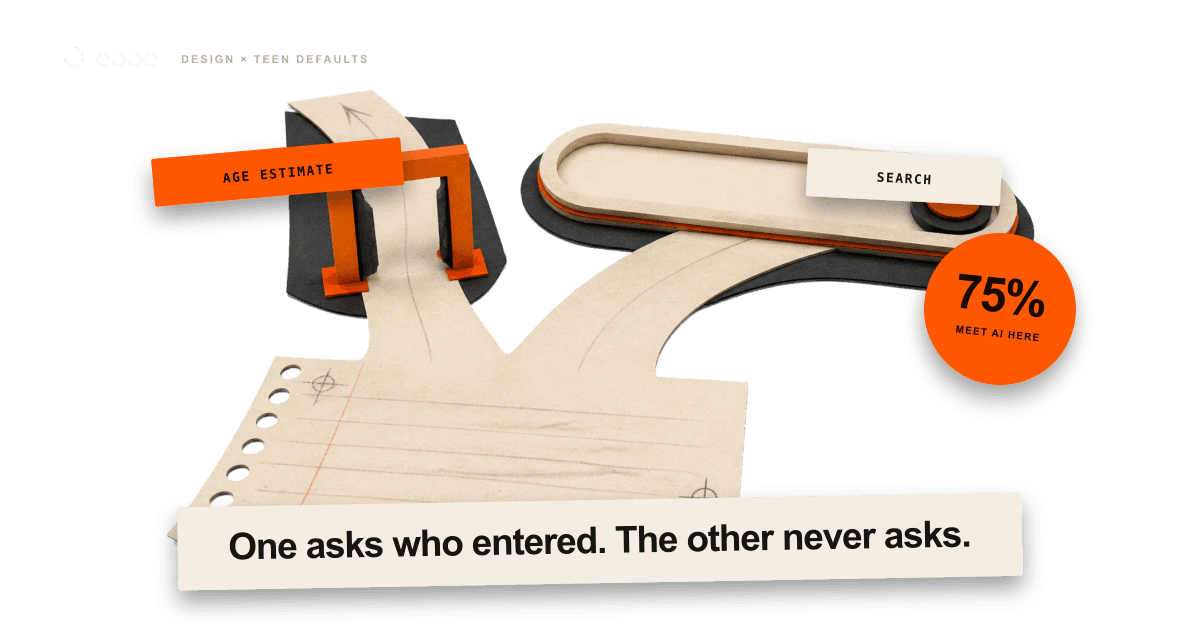
On 18 August 2026 OpenAI launched ChatGPT for Teens, a version of ChatGPT that people under 18 are placed into automatically. The next day Google put practice quizzes, camera-based homework coaching and generated simulations inside Search. Both were answering the same question — where does protection for a minor live — and answered it differently. OpenAI built a separate room you are shown into partly on a guess about your age. Google put the tools in the one place that never asks.
That is a product decision before it is a policy one, and not only for companies that build assistants. If a fourteen-year-old can reach what you built, your product already behaves some way when it cannot tell who is there. Most teams have never written that behaviour down.
What ChatGPT does when it can't tell your age
Age prediction — a model that estimates whether an account belongs to someone under 18 instead of asking them to prove it — was already rolling out on ChatGPT consumer plans when OpenAI described it on 20 January 2026. OpenAI names the inputs: how long the account has existed, the times of day the person is usually active, usage patterns over time, and whatever age they stated at signup. None of that is proof, and OpenAI does not claim it is. What it states is the direction of failure, the part worth copying: "When we are not confident about someone's age or have incomplete information, we default to a safer experience."
ChatGPT for Teens is where that default now lands. "If our system estimates someone is under 18 or they state their age is between 13 and 17, they are automatically placed into ChatGPT for Teens," OpenAI wrote on 18 August. Inside it, protections are not settings a parent has to find: study mode, reminders that redirect a teen who appears to be shortcutting an assignment, break reminders, and an under-18 model spec — the document that sets how the model should behave — under which ChatGPT should not use romantic language, encourage emotional dependence, or imply that it has feelings.
The two ways that guess can be wrong do not cost the same, an asymmetry OpenAI does not address. An adult classified as a teen loses capability and gets a correction path: a selfie through Persona, an identity-verification service. A teen classified as an adult loses the protections and gets nothing, because nobody complains that a product treated them as too grown up. Choosing which error you would rather make is the real design work.
Google shipped the same capability where there is no door
Google's announcement on 19 August lists what students can do inside Search. Practice quizzes for the ACT, AP, ENEM, GRE, JEE, LSAT, MCAT, NEET and SAT, free, in English, in both AI Overviews and AI Mode — Search's AI summary and its chat tab. Lens turned into a tutor: photograph the exercise you are stuck on and Search "pinpoints where you may have made mistakes".
Google calls all of it "education tools that are built to be safe by design". Read against both posts, that is a claim about where the content comes from — the quizzes draw on The Princeton Review, Careers360, PhysicsWallah and Akira Enem — not about who is asking. Neither that post nor the back-to-school collection mentions a minimum age, a mode for minors, or parental controls. The only eligibility test in the announcement is the giveaway: a free year of Google AI Pro for eligible US college students.
Where do kids actually meet AI?
Common Sense Media surveyed 1,204 US children aged 9 to 17 and published the results on 8 June 2026. 86% use AI in some form, and the most used kind is not the chatbot: "AI-generated summaries in search engine results are the most widely used form of AI among 9- to 17-year-olds, with 75% having used or interacted with them", against 67% for chatbots. Among the children who use AI, 85% use it for schoolwork.
The report names the structural reason: social networks required teens to sign up and make a profile, while AI tools are "embedded in products that teens already use (e.g., Google Search)" or, like ChatGPT, work without signing up. The surface where the most under-18s meet AI has no account, no age question and no second mode. Protection that depends on a boundary never reaches them, because they never cross one.
The default your product already has
Building a teen mode is a decision for the handful of companies that ship an assistant. Deciding what to do with a user you cannot identify is a decision every product makes, usually by omission — a comment field, a chat, an upload. Two questions deserve a deliberate answer: what does this do when we do not know, and which way have we chosen to be wrong?
Our position is that for most products the answer is not to branch. Branching on an identity you cannot verify costs twice — two experiences to keep consistent, plus a verification path that ends with asking adults to send their face to a third party — and pays off only where the adult experience is worth that much. Setting the floor for everyone costs once: defaults that are safe for the youngest plausible user, with sharp edges available on request rather than by assumption.
The smallest item on OpenAI's list is the one most products can copy now: "product cues that consistently identify ChatGPT as AI". Persistent, boring cues beat a one-time notice, the argument we made about the sparkle icon from the legal side.
What to watch is how guessing before asking plays out in Europe: OpenAI said in January that age prediction would reach the EU "in the coming weeks to account for regional requirements", and the August post does not say whether it did. Meanwhile Pew reported on 18 August that for the first time a majority of US adults under 30, 55%, are more concerned than excited about AI. The teenagers being sorted by an age estimate today are a few years younger than that group.
Sources
- OpenAI, Introducing ChatGPT for Teens, 18 August 2026.
- OpenAI, Our approach to age prediction, 20 January 2026.
- Google, 5 new ways to level up your learning with Search, 19 August 2026.
- Google, Back to School 2026, 19 August 2026.
- Common Sense Media, Census: AI Use by Tweens and Teens, 8 June 2026.
- Pew Research Center, Young adults in the U.S. are increasingly wary of AI, 18 August 2026.
![[object Object]](/_next/image?url=https%3A%2F%2Fres.cloudinary.com%2Fdh1xrwguk%2Fimage%2Fupload%2Fv1790966353%2Fblog%2Fbook-of-shapes-rules-v3-transparent.png&w=3840&q=75)
![[object Object]](/_next/image?url=https%3A%2F%2Fres.cloudinary.com%2Fdh1xrwguk%2Fimage%2Fupload%2Fv1790707343%2Fblog%2Fopenai-dots-delegation-product-v4-transparent.png&w=3840&q=75)
![[object Object]](/_next/image?url=https%3A%2F%2Fres.cloudinary.com%2Fdh1xrwguk%2Fimage%2Fupload%2Fv1790264631%2Fblog%2Fai-agents-need-containment-en.png&w=3840&q=75)