
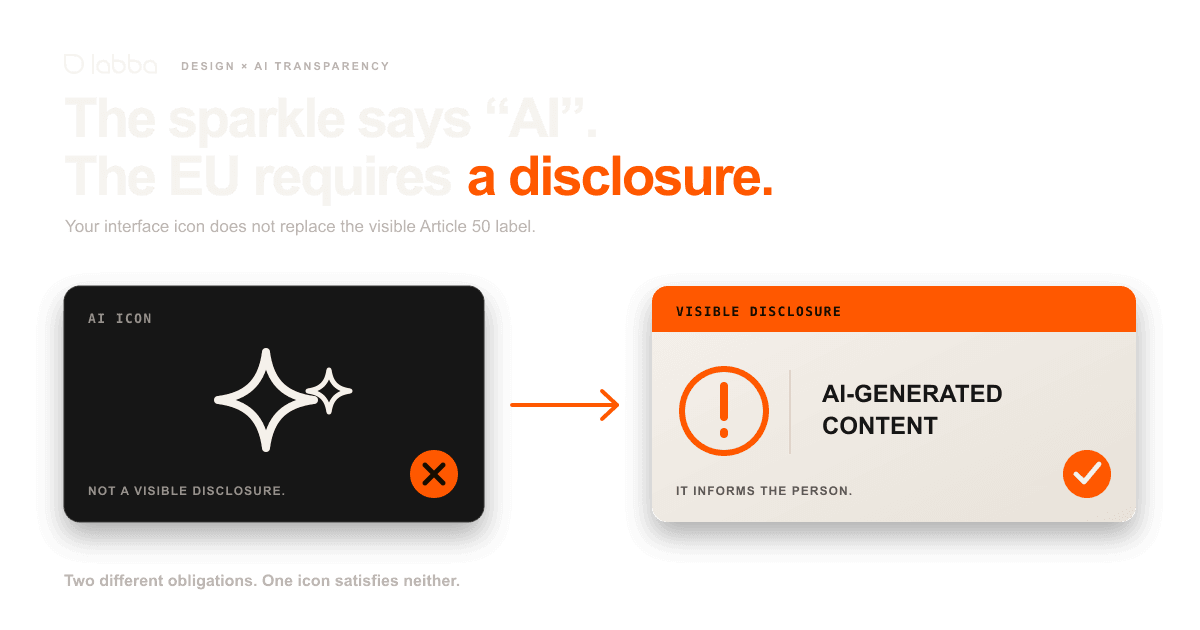
Since 2 August 2026, Article 50 of the EU AI Act has required two different AI labels. One is an invisible mark on the output, readable by software, owed by whoever makes the model. The other is a visible disclosure, owed by whoever ships the interface, to the person in front of it. The sparkle icon that became the house style for AI features is neither of them — and the European Commission says as much about its own official icons.
The two halves land on different companies. The AI Act calls whoever builds an AI system and puts it on the market the provider, and whoever uses one inside their own product the deployer. If your product calls an API from OpenAI, Google or Anthropic, they are the provider and you are the deployer. Their half is technical and already being done for you. Yours is an interface decision, and it does not arrive with a component.
What does Article 50 actually require?
Article 50(2) makes providers of generative AI mark their output “in a machine-readable format and detectable as artificially generated or manipulated”: a signal carried inside the file or the text, which software can read and a person cannot see. The Commission then closes the obvious shortcut, saying deployers “cannot simply rely on the machine-readable marking embedded in the content by the provider” to satisfy their own duty.
That duty is the human-facing one. Article 50(4) requires disclosing a deep fake — synthetic image, audio or video resembling real people, places or events that would falsely appear authentic — and, separately, disclosing AI-generated text published to inform the public on matters of public interest. The second has an exit the first does not: it falls away where the content “has undergone a process of human review or editorial control and where a natural or legal person holds editorial responsibility for the publication”. A named editor is a compliance strategy. A spellcheck pass is not.
Article 50(1) covers the chatbot case: people interacting directly with an AI system have to be informed of it, “unless this is obvious from the point of view of a natural person who is reasonably well-informed, observant and circumspect”. And 50(5) fixes the form for all of it — the information goes to people “in a clear and distinguishable manner at the latest at the time of the first interaction or exposure” and “shall conform to the applicable accessibility requirements”. That last clause is where this stops being a legal footnote. A disclosure a screen reader skips is not a disclosure.
The EU wrote the placement spec, and it still is not compliance
The Commission published its own icon set for AI-generated content, free to use in SVG and PNG, and attached rules that read like a design review. The icon “should be placed where no intervening overlay elements exist” and “must be visible when content is reshared or downloaded”, which is a requirement about your Open Graph image and your download endpoint rather than your component library. Where possible it “should be readable by assistive technologies using alt text or ARIA labels”, and a disclosure shown briefly “should remain visible long enough to be read and understood by users with cognitive or processing difficulties”.
Then, on the same page: “The use of these EU icons is optional, but the labelling requirements under Article 50 AI Act are not. The use of these icons does not establish legal compliance by itself.” If the official icons do not get you there on their own, with a placement spec attached, a sparkle pulled from a component library certainly does not. That icon was never built to disclose anything — it spread because it reads as this part is the magic, a marketing signal that says a feature uses AI. Article 50 asks you to say the thing in front of the reader was made by one, which usually needs words. The Commission user-tested its icons and found “performance improved across all measures when the basic icon was accompanied by a text label”.
The invisible label became mandatory. The visible one became a preference.
On 14 August 2026 Anthropic published how Claude's text watermark works, and gave the reason without hedging: “We’re implementing watermarking to comply with the EU AI Act.” The method leans on the model's choice among equally good words to leave a statistical pattern a detection key can find, and from the outside it changes nothing: “to a reader, a watermarked response is indistinguishable from an unwatermarked one”. Generated files carry a content credential instead — a cryptographically signed note in the file’s metadata.
Google moved the other way on the part people can see. Gemini now has a Media Watermark setting, and Google's help page draws the line: it “only controls the visible watermark. It doesn’t affect SynthID watermarks or Content Credentials”. SynthID is Google’s invisible watermark, and it stays in the file whatever the user picks. The badge in the corner of the image is a user preference now. The signal inside the file is not.
Our read is that the visible label has been handed down the stack: model vendors cover the part software can verify and leave the part a person has to read to whoever builds the screen. No regulation says that, but it is what the two obligations add up to once one is automated and the other is not.
What to check in your product this month
None of this needs a legal review to start. It needs someone to open the product and look, which puts it with the rest of the product design work rather than in a compliance pass at the end.
- Chat entry points. Is the disclosure in the first message and inside the interface, or in a policy page a user would have to go and find?
- Published text. AI-written content on matters of public interest needs a label unless a named person holds editorial responsibility for it.
- Synthetic media. Including the version that survives a reshare or a download.
- The accessibility tree. A decorative icon with no accessible name never reaches a screen reader.
The ceiling for a breach, in the Commission's own summary, is “up to €15M, or up to 3% of total worldwide annual turnover” — a ceiling, not a forecast. What comes next is a wording problem before it is a legal one. Either a convention forms and people learn to recognise a disclosure on sight, or every product writes its own and the label ends up technically present and practically unread, which is the state the sparkle is already in.
Questions people actually ask
Does everything my product generates with AI need a label?
No. The European Commission states that “not all AI-generated or manipulated content needs to be labelled”. The deployer's disclosure duty under Article 50(4) covers deep fakes and text published to inform the public on matters of public interest — a generated product description or an internal draft is not in scope. The provider's machine-readable marking under 50(2) applies to the output either way.
What counts as the human review that exempts published text?
Something substantive. The Commission defines human review as “the deliberate examination of the substance of the content by one or more natural persons possessing relevant knowledge and professional judgement”, and editorial control as control by a responsible editorial entity with the authority to approve, alter or reject the text. It adds that “superficial, solely formal, or procedural checks (e.g. spell-checking or grammatical correction) are not considered to be human review or editorial control”.
What is the deadline?
Article 50 has applied since 2 August 2026. Systems already on the market before that date have until 2 December 2026, and that grace period covers only the marking and detection obligation under Article 50(2). The disclosure duties that land on the interface got no grace period at all.
Sources
- European Union — AI Act, Article 50, Official Journal
- European Commission — Transparency obligations under Article 50
- European Commission — EU icons for labelling AI-generated content
- European Commission — Quick facts: transparency rules
- Anthropic — How Claude’s text watermark works, 14 August 2026
- Google — Manage watermark settings in Gemini Apps
![[object Object]](/_next/image?url=https%3A%2F%2Fres.cloudinary.com%2Fdh1xrwguk%2Fimage%2Fupload%2Fv1790707343%2Fblog%2Fopenai-dots-delegation-product-v4-transparent.png&w=3840&q=75)
![[object Object]](/_next/image?url=https%3A%2F%2Fres.cloudinary.com%2Fdh1xrwguk%2Fimage%2Fupload%2Fv1790264631%2Fblog%2Fai-agents-need-containment-en.png&w=3840&q=75)
![[object Object]](/_next/image?url=https%3A%2F%2Fres.cloudinary.com%2Fdh1xrwguk%2Fimage%2Fupload%2Fv1790083249%2Fblog%2Fsoftware-didnt-die-it-multiplied.png&w=3840&q=75)