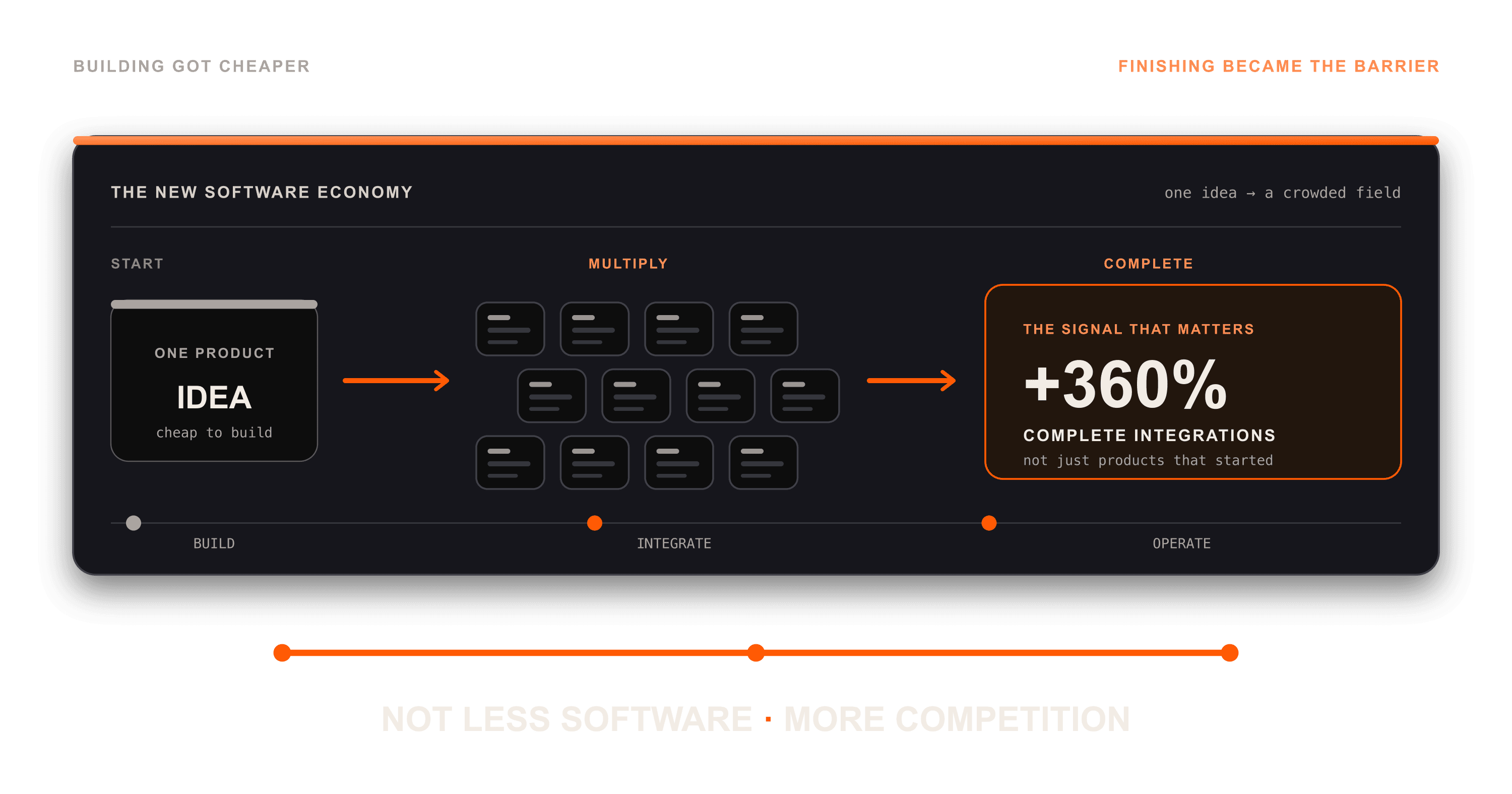
On 17 September 2026 Stripe published a number that looks like good news: new platform businesses on its network are up over 180% year over year across three months. Stripe reads it as the January software panic being wrong. Our read is the opposite. More software companies is what commoditisation produces, not what refutes it: cheap to make means more people make it. If your product competed on being finished and working, that position just got crowded.
The panic had a name. Beginning in late January, according to Stripe, software companies shed roughly $1 trillion in market capitalisation in 30 days, on the theory that agentic AI would make software cheap enough to build that nobody would pay much for it. The headlines called it the SaaSpocalypse, a pun on software as a service. Prices have since returned to roughly where they started.
What changed is not whether software survives. It is what a customer is still willing to pay for, now that the tooling is good enough to put everyone at the same finish line.
What Stripe actually counted
Stripe reports three things measured on its own network. New platform businesses, meaning software companies that handle payments on behalf of their own customers, are up over 180% year over year across three months, and Stripe added more of them in those three months than in the last six months of 2025. Platforms that went live in January 2026 are reaching $1 million in payment volume at a higher rate than any previous cohort did at the same point. And as of August 2026, over 55% of new Stripe integrations involve some form of AI assistance. Stripe says it checked the new arrivals by manual review, LLM classification and heuristic checks, and found legitimate businesses with real customer activity.
The limit belongs here rather than after the conclusion. Stripe can see businesses that chose Stripe, and sells to them. It cannot see the software market. Part of that 180% is Stripe growing rather than software growing, in a period when Stripe was shipping documentation and tooling built to make its own integration faster. The number is real, and what it measures is narrower than the headline suggests.
The number that matters is the other one
Lower down the same post sits the figure that carries the argument: the number of self-serve SaaS platforms on Stripe building complete integrations is up roughly 360% year over year. Stripe describes those as platforms that moved beyond experimentation and built the full capabilities their merchants need.
That measures finishing, not starting. Our read is that in a year the distance between a working demo and a shippable product collapsed. Founding a software company was never the hard part. Getting one finished was, and finishing is the part that got automated.
Why it got cheap
The mechanism is visible one layer down. Vercel publishes a monthly index of the traffic running through its AI Gateway, the service that sits between an application and the model providers it calls. In the September 2026 edition, the price per token fell 23.2% in August, the third consecutive monthly drop, and the average token now costs less than half what it did five months earlier. Open-weight models, meaning models whose weights are published so anyone can run them on their own hardware, went from 7% of that traffic in December to 56% in August while accounting for 14% of the spend.
Vercel measures its own gateway and estimates spending from published list prices, so the levels are loose and the direction is firm. The direction is that the raw material of an AI feature gets cheaper every month, and that the expensive models are being kept for the work that needs them.
What is left to charge for
ICONIQ surveyed around 300 executives at software companies building AI products in the second quarter of 2026 and stated it plainly: "AI is no longer a differentiator on its own. It has become a core expectation." In the same report, pricing is being rebuilt around that: consumption-based pricing rose from 35% to 42% in six months and outcome-based pricing from 18% to 23%. The survey covers companies already building AI products, so it describes the people still in the game rather than the market as a whole.
The most useful sentence in Stripe's post is not Stripe's. Eric Noeth, a partner at the private equity firm Advent, offers a test: "A high-signal indicator of platform defensibility is what breaks the day the customer turns it off. If operations keep running, the product is more exposed."
That is not an engineering question. Nothing in a model decides which workflow your product owns, what it stores that a customer could not reconstruct elsewhere, or what it refuses to do. Those are product and design decisions, and they now carry the whole of the difference, because the work that used to take a year of engineering takes a quarter. Our position: the teams that struggle over the next two years will be the ones that kept spending their scarce judgement on the half that got cheap.
What to do with this
Run Noeth's test on your own product and answer it honestly. If the worst that happens when a customer switches you off is mild inconvenience, more engineering will not fix that, and neither will a redesign. The repair is upstream, in picking a narrower job and owning it completely. It is the same shape as the finding that two thirds of AI-written pull requests never merge: volume was never the constraint.
Pricing is where this gets settled, and it is worth watching over the next six months. A company admits what it believes it is selling at the moment it sets a price. When a product stops charging per seat and starts charging per result, it has decided the work is the product. When it keeps charging per seat while shipping AI features that do the work of several seats, it is selling something it has already stopped believing in.
Sources
- SaaS platforms are surging despite the SaaSpocalypse, Stripe, 17 September 2026.
- AI Gateway Production Index, September 2026, Vercel, 17 September 2026.
- 2026 State of AI Report: The Builder's Economy, ICONIQ Growth, July 2026. Survey of around 300 executives, second quarter of 2026.