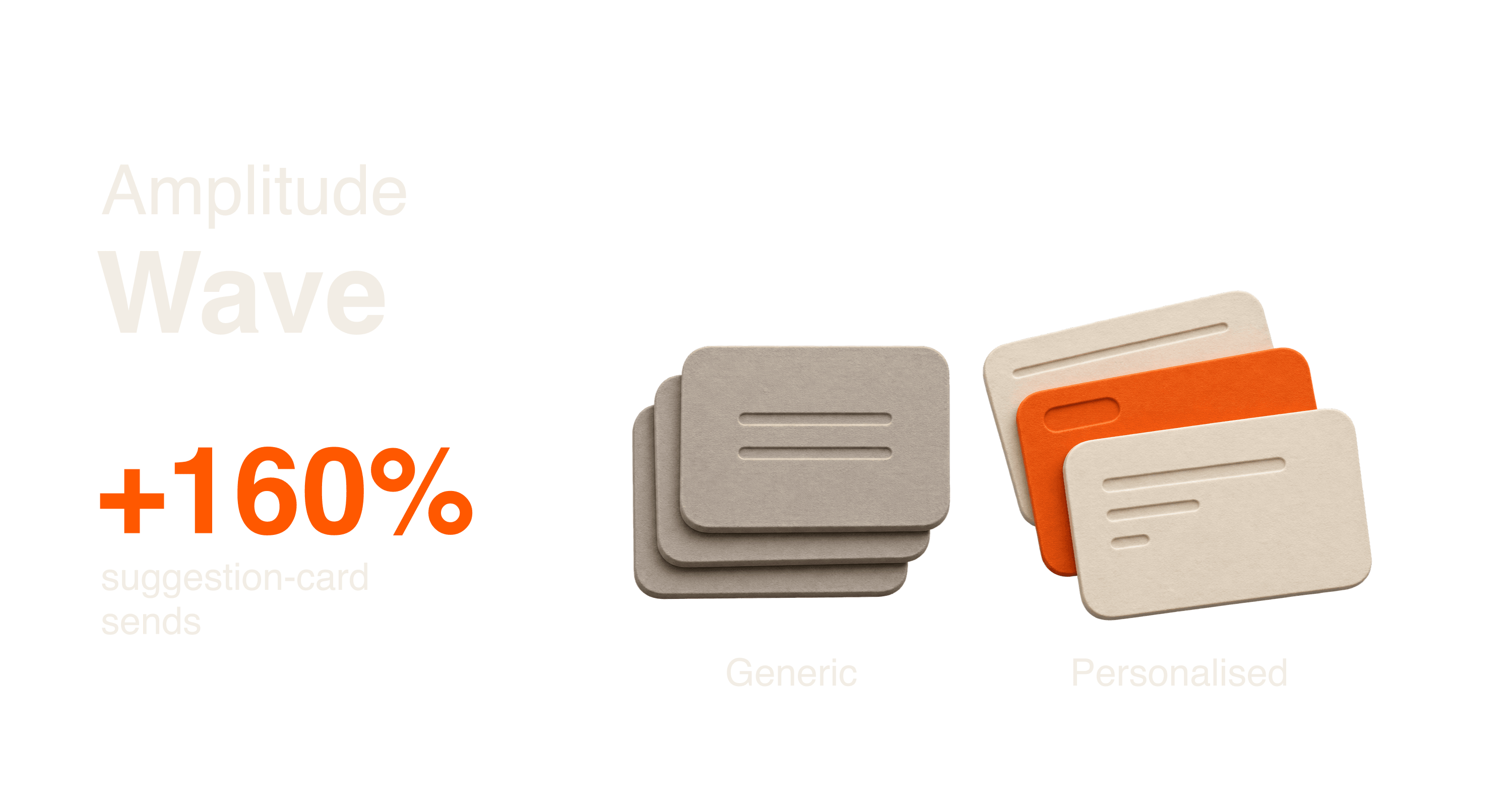
Amplitude is a platform for analysing how people use digital products. On 12 November 2026 it launched Wave, an agent that also proposes what to improve. On its own homepage, Amplitude had suggestion cards to help people start a conversation with its AI agent, and few people used them. Its new agent, Wave, went through 100 session replays and found that 80 people typed their own question and only 12 picked a card.
Wave proposed personalising the cards with each person's recent charts and dashboards. After a short review, the team handed the plan to a coding agent and ran an A/B test. According to the customer story OpenAI published on 12 November 2026, messages sent through the cards rose 160% against control after one day.
The impressive part isn't the percentage. It's the loop: an agent watched recordings, found a pattern, proposed a change with a technical plan, got it to a coding agent and left the measurement in place. That's real product work. Because the loop works, the hard part moves. Wave doesn't decide which number counts as the product getting better, and it shouldn't. If you build or run a product, that definition is now the decision that costs most when it's wrong.
What does Amplitude Wave actually do?
Amplitude describes Wave as a "proactive product agent". You give it a product area and a goal. It reads behavioural data, session replays, customer feedback and, if connected, the code, then writes up an "Opportunity": evidence, a proposed change and a hypothesis. It sends a technical plan to a person or a coding agent such as Codex, and measures the result after the change ships.
People stay in the loop. On Wave's product page, the team sets the outcome and guardrails, and the coding agent opens pull requests for the team to review. In OpenAI's story, bug fixes usually go straight to coding agents, while new features get a human review. On the 4 November earnings call, CEO Spenser Skates said: "it is not fully automated yet."
It's also not a switch you flip. Wave is a paid offering for Growth and Enterprise customers, and it needs solid Product Analytics and Session Replay data plus people to review what it suggests. Skates said Amplitude would "go deep and big with a few" customers first. The "1 to 2 days" in OpenAI's headline is, by the story's own wording, an Amplitude estimate.
What rose 160%?
Amplitude product manager Jacob Newman gives the raw numbers: 2.43 suggestion sends per 100 exposed users with personalised cards, against 0.94 with generic ones, in an experiment run in July 2026. Newman himself calls the 160% "only an initial test readout that still requires further validation".
In absolute terms, that's 1.49 more messages per 100 exposed users. It doesn't invalidate the result, but it gives the scale: the change multiplied an action that was rare to begin with.
The figure measures one way into the chat: clicking a card. Neither company reports whether people asked more questions overall or just clicked instead of typing. Saving someone the typing is a small, real improvement. More people getting value from the agent is a different claim, and our read is that the published experiment says nothing about it.
Newman is candid about his weaker results too, so this isn't a gotcha. The issue is structural. An agent that finds and measures opportunities reports the metric it was given, and in a cheap, fast loop there's a real risk that the metric that moves most easily ends up winning.
The bottleneck moves before the code
When a coding agent can write the change in an afternoon, the costly mistake stops being building the wrong thing slowly. It becomes shipping many small things quickly, each lifting a local number, with nobody checking whether the product as a whole got better.
Amplitude's own launch post has a better example. Mewtant, the team behind the image generator PixAI, wanted new users to come back. Wave found that publishing artwork correlated with retention and suggested prompting people to publish after generating an image. The team adapted the idea: when users run out of credits, a tooltip now points them to Missions, where publishing earns free credits. PixAI reported a 76% rise in Missions opens, nearly 10% more publishing and a 3% rise in day-one retention. Customer-reported, not audited, but the shape is right: a local action, then the business outcome, and people deciding how to use the agent's idea.
Before connecting an agent like this, three things should be written down by people:
- The goal metric, and why it reflects value for the user and the business rather than activity.
- A guardrail metric that must not get worse, such as retention, support tickets or total usage.
- How long a test runs before anyone believes it. A one-day test can catch a real effect, but it can't tell you whether it lasts.
None of this is new. What Wave changes is the volume: many more results that look like answers, each only as good as the question a person wrote. It's the argument we made about AI in ecommerce recommendations: ask which outcome changes, not how much AI there is.
Skates told investors to expect results from Wave "over the next few quarters". Watch which numbers they report. An agent that can do this much of the work is a genuine step forward, and it raises the bar for the part it can't do: if the results are clicks and engagement, the loop has only become faster. If they include retention and revenue, it is getting better at the part that was always hard.
Sources
- What will you build with infinite engineers?, Amplitude, 12 November 2026.
- How I use Wave to find Amplitude's next product improvement, Jacob Newman, Amplitude, 9 November 2026.
- Amplitude Wave product page and FAQ, Amplitude, accessed 19 November 2026.
- How Amplitude ships product improvements in 1–2 days with OpenAI, OpenAI, 12 November 2026.
- Amplitude Q3 2026 earnings call transcript, The Motley Fool, 5 November 2026 (call held 4 November).