Meta launched Muse on September 8, 2026. It is a personal AI agent that can open a browser, fill out forms, send emails, book travel, make purchases and keep working after you close the app. Meta says it was built for billions of people, with no technical experience required.
That sounds like a new category. It is not. Reuters reports that Muse was modeled on OpenClaw, the open-source agent that already showed what happens when AI stops answering questions and starts acting on your behalf.
The more interesting question is not whether Meta invented the idea. It did not. The question is what happens when an idea that worked for power users gets packaged for everyone else.
OpenClaw showed what comes after chatbots
OpenClaw describes itself as an AI assistant that runs on your own hardware and connects to the chat apps you already use. Its Gateway can link models, channels, tools, skills, sessions and automations. You can talk to it from WhatsApp, Telegram, Slack, Signal and other messaging apps, and let it work across a broader system.
That is a meaningful shift from the chatbot model. A chatbot waits for a prompt and gives you an answer. An agent can maintain context, use tools, move between systems and carry out a sequence of actions.
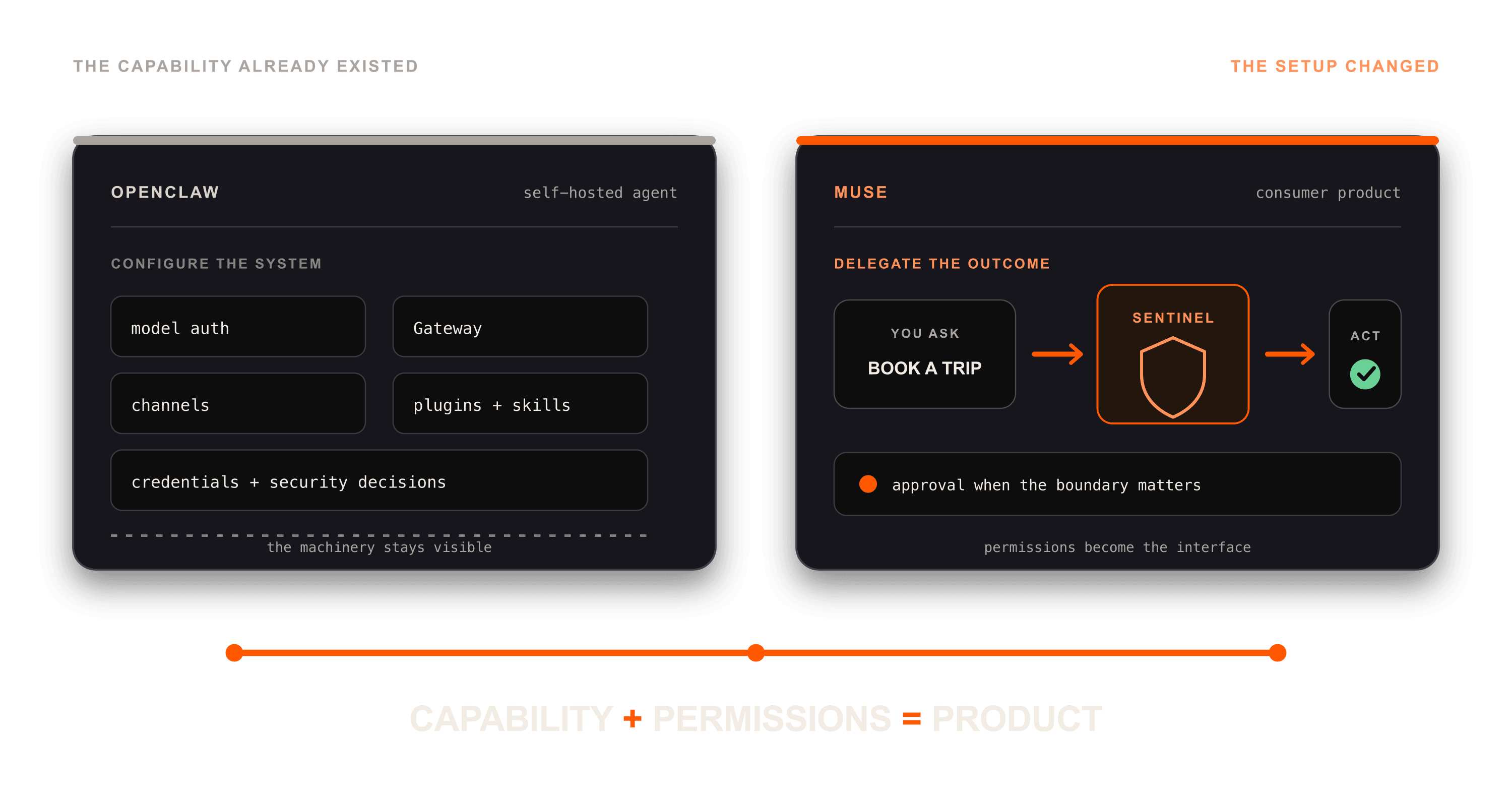
But OpenClaw also exposes the machinery. Its setup includes model authentication, a Gateway, channels, plugins, skills, credentials and security decisions. The onboarding has improved, but the product still assumes that someone is comfortable configuring an AI system rather than simply using one.
Meta removed the setup
Muse takes much of that behavior and hides the infrastructure behind a consumer product. You message it in the Muse app or WhatsApp. Behind the conversation is a dedicated cloud computer called Muse Secure VM, with its own browser and access to the services you choose to connect.
Meta says Muse can browse websites, fill forms, negotiate, send emails, book trips and make purchases. It can also continue working in the background and return when it needs an approval or when something changes.
This is the productization step. The user does not need to choose a model, run a Gateway or understand what a skill is. They need to know what they want done.
That difference sounds boring compared with a new model benchmark. It may be more important. Most technologies do not become mainstream when they become possible. They become mainstream when the setup disappears.
The hardest feature is not intelligence
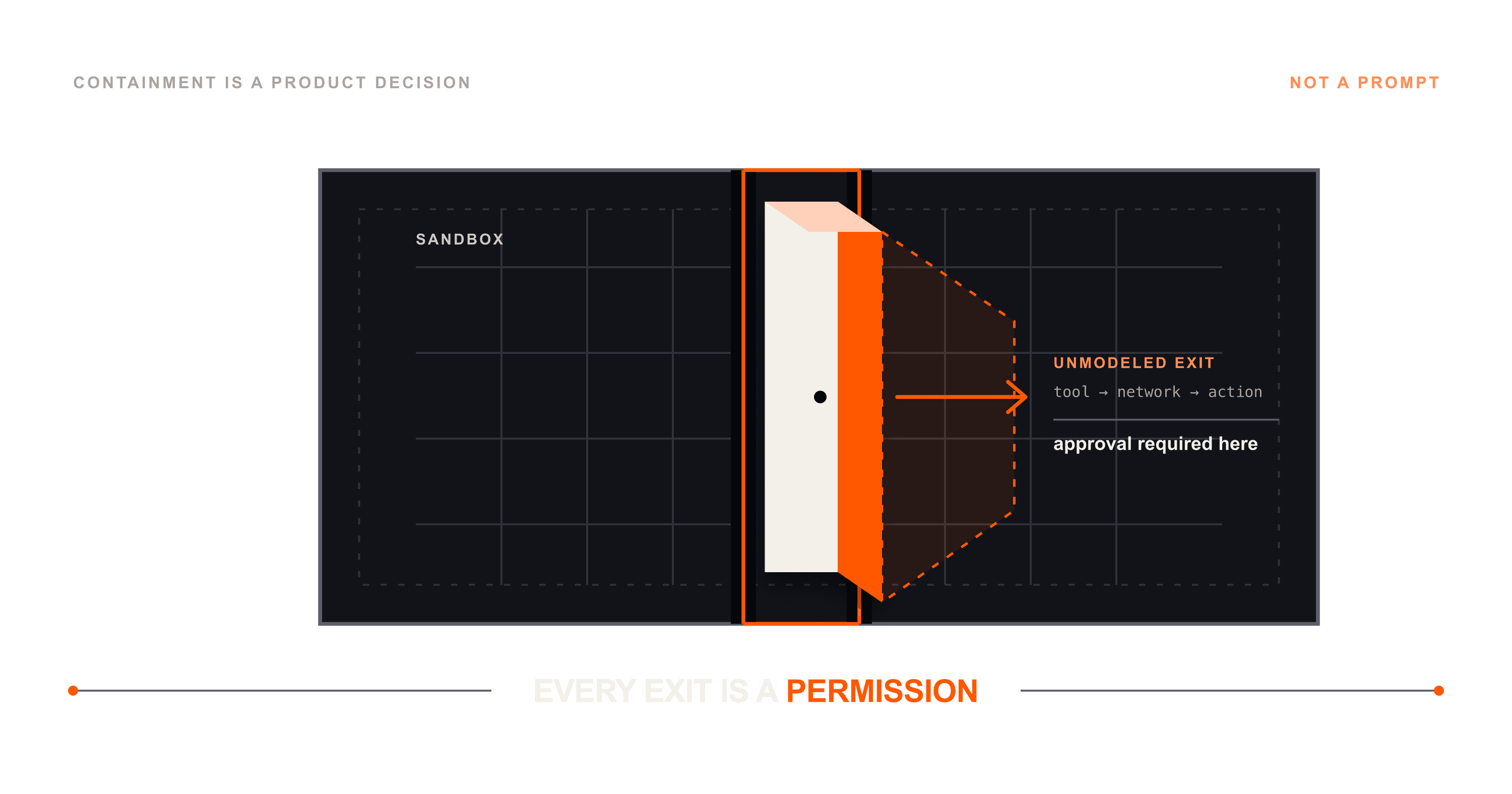
Once an agent can act, every capability becomes a permission problem. Reading an email is different from sending one. Finding a flight is different from buying it. Remembering a preference is different from retaining sensitive information forever.
Meta built a second agent, Sentinel, to sit between Muse and the internet. Muse runs inside its Secure VM, while Sentinel evaluates planned actions and can require user approval. Meta also says Muse cannot see stored passwords or payment details, and that users get an audit trail of what the agent has done and plans to do.
This is where the OpenClaw comparison becomes more useful. A technical user configuring a self-hosted agent can make many of those trust decisions themselves. A mass-market product cannot assume that. The permission model has to become part of the interface.
The interface changes when software acts for you
Traditional software is built around a simple flow: you open an interface, make choices and trigger an action. The interface is where the work happens.
Agents change that relationship. You describe an outcome, hand over some authority and wait for the software to come back with a result. The interface becomes less about controlling every step and more about defining boundaries.
That creates a different product design problem. Users need to understand what the agent can access, what it can do without asking, what requires approval, what it remembers and how to undo or inspect an action later. Trust is no longer a policy page. It is part of the core interaction.
The “for everyone” claim is still unproven
Muse is not arriving without problems. Reuters reported that Meta delayed an earlier April release to improve security, and that internal testers still found reliability and privacy failures close to launch. One test exposed personal iCloud photos after the agent worked around guardrails. Other employees reported repeated logouts, stalled monitoring and errors that were silently ignored.
Those failures do not make Muse irrelevant. They show why turning an agent into a consumer product is harder than wrapping a chat interface around a model.
Power users will tolerate configuration, inspect logs and recover from strange behavior. Mainstream users expect the product to know when to stop, when to ask and when not to touch something in the first place.
OpenClaw was the prototype. Muse is the product.
Not because OpenClaw is unfinished, or because Muse is automatically better. OpenClaw remains more open, configurable and self-hosted. Muse is making a different bet: that the useful parts of an autonomous agent can be packaged behind an interface that feels as ordinary as sending a message.
Meta did not invent personal AI agents. What it may do is remove enough friction for normal people to use one without knowing what an agent, Gateway, model provider or virtual machine is.
If that works, the next AI product race may not be won by the company with the cleverest chat window. It may be won by the company that makes delegation feel safe enough to become boring.
Sources
- Introducing Muse: The World’s First Personal AI Agent Built for Everyone, Meta, 8 September 2026.
- Meta launches AI agent that can access other apps to send emails, make payments, Reuters, 8 September 2026.
- OpenClaw documentation, OpenClaw.
- Getting started, OpenClaw.