For years, the design-to-code pipeline moved in one direction. Designers handed off. Engineers interpreted. Something got lost somewhere in between. Everyone sighed. Repeat. That loop is officially broken.
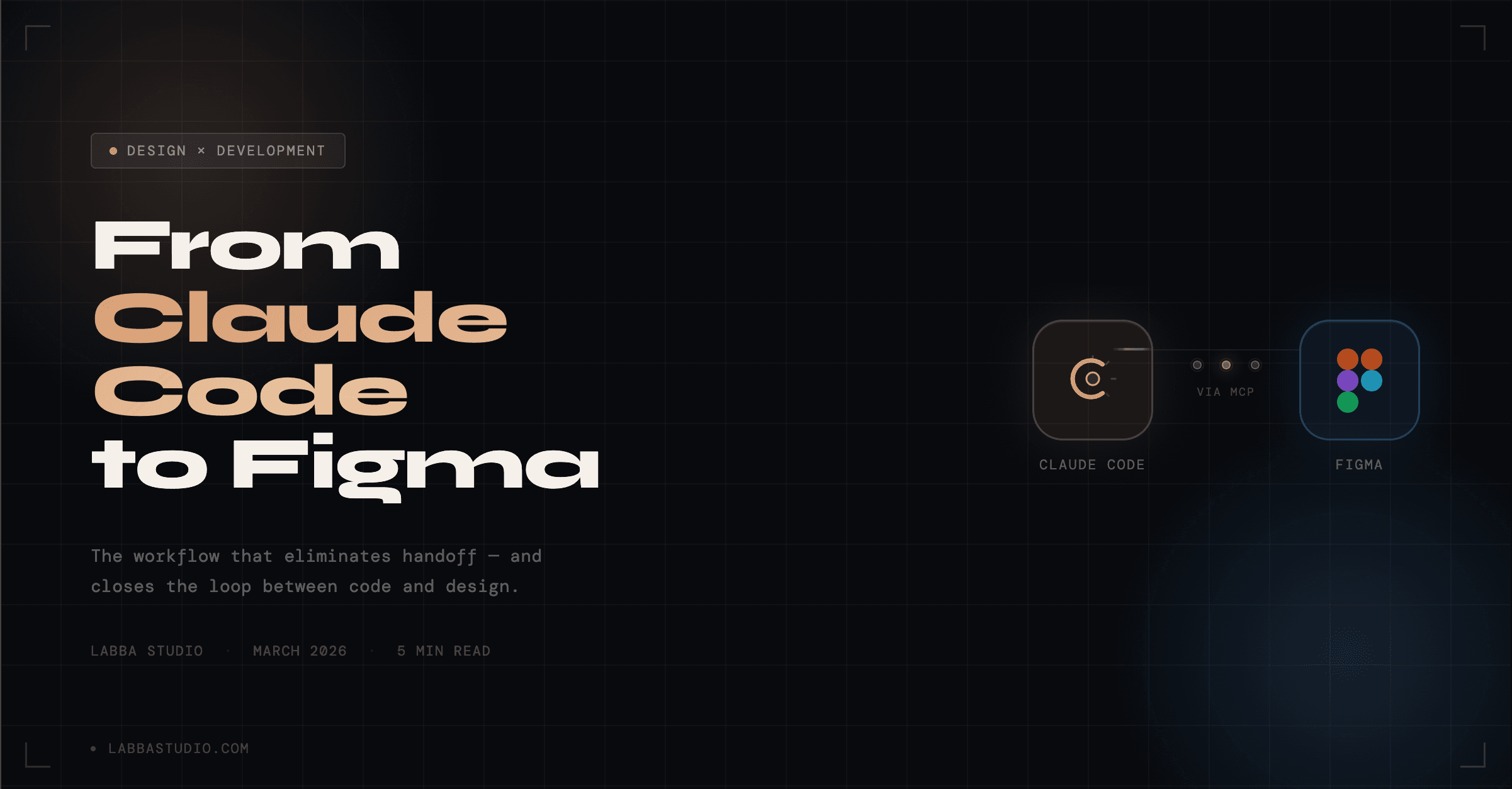
On February 17, 2026, Figma announced a native integration with Claude Code — Anthropic's agentic coding tool — that lets developers capture a live, functioning UI from a browser and convert it into fully editable frames on the Figma canvas. Not a screenshot. Not a flattened image. A real design artifact that your team can annotate, rearrange, and iterate on.
This is the reverse handoff. And it changes everything.
Why This Matters
AI coding tools have made it almost trivially easy to go from idea to working prototype. You describe what you want, and you get a functioning interface in minutes. The challenge has always been: what happens next?
Once you have something built, you need to share it, evaluate it, align on it, and refine it — together. That's where code-first workflows have always struggled. A running app on localhost isn't a great collaboration surface. You can't annotate it. You can't drag things around. You can't paste it next to three other variants and compare.
That's exactly the problem this integration solves. By bringing a coded interface into the Figma canvas, you enter a shared space where designers, developers, and stakeholders can actually work together — without needing to touch the codebase.
How It Works
The integration runs on top of Figma's MCP (Model Context Protocol) Server, a standardized bridge that allows AI agents to interact with Figma's design data — reading components, variables, styles, and layout structure — rather than just passing screenshots.
The workflow looks like this:
1. Build in Claude Code Start a local dev server or point to a staging or production URL. Claude Code works with anything running in a browser.
2. Prompt the capture Ask Claude: "Start a local server for my app and capture the UI in a new Figma file." The integration opens a browser and gives you a capture toolbar to select pages, states, or entire flows.
3. Land on the canvas The captured UI appears in a new Figma file as an editable frame — not a static image. You get real layers, real structure, and real editability.
4. Collaborate Your team annotates what's working, calls out what's unclear, duplicates frames, compares variants. Designers can work in their native environment without needing repo access or a dev environment.
5. Close the loop Share the updated Figma link back with Claude Code. It reads the design and rewrites the code to match. Code-to-design-to-code. A full circle.
What This Means for Teams Like Ours
At Labba, we've always believed that the gap between design and development isn't a tools problem — it's a workflow problem. The tools are only useful when they stop forcing people to context-switch and start letting each discipline work in their native environment.
This integration gets us closer to that ideal than anything we've seen before.
A few things change immediately:
Evaluation gets visual. Once a coded UI is on the canvas, side-by-side comparisons become possible. Patterns, inconsistencies, and gaps are easier to spot when you can literally place two screens next to each other and zoom in.
Collaboration happens earlier. You don't need a polished prototype to gather feedback. A Claude Code-generated interface — rough edges and all — can land in Figma and become the basis for a real design conversation.
Multi-screen flows finally make sense. You can capture an entire user journey in a single session: onboarding, checkout, settings. The sequence and context are preserved. The canvas becomes a decision-making space for the full experience.
Rejected ideas stay visible. Instead of losing early explorations to git history, you keep them on the canvas. Future reference, design rationale, alternative paths — all accessible to the team.
The Honest Limitations
This is genuinely exciting, but it's not magic. A few things worth knowing before you build your whole workflow around it:
It's terminal-first. Claude Code lives in the command line. Designers who aren't comfortable there will need some support during setup. The learning curve is real, though it's shorter than it used to be.
Updating existing code is still manual. Claude Code is excellent at generating new components from scratch. But when a design evolves and you need surgical updates to existing code, you're still doing that by hand or re-generating from scratch.
Multi-frame complexity adds up. Complex interactive flows — carousels, multi-step forms — require capturing frames individually and then combining them. Each step takes tokens and coordination.
No visual refinement loop (yet). Once you're back in code, tweaking padding or hover states still means editing code. There's no in-tool visual feedback — at least not yet.
The Bigger Shift
What's actually happening here is bigger than any single feature. Nine days later, on February 26, 2026, Figma announced the equivalent integration with OpenAI's Codex — positioned as complementary, not competing. Different starting points, same destination.
Whether you start on the canvas or in the terminal, the goal is the same: get to something real, then take it further.
The boundary between design and development has been softening for years. This integration accelerates it. For studios like Labba — where design and engineering share a table from day one — it's the closest thing we've seen to a genuinely closed loop.
The handoff isn't dead yet. But it's on notice.
Sources
- From Claude Code to Figma: Turning Production Code into Editable Figma Designs — Figma, 17 February 2026.
- OpenAI Codex and Figma launch seamless code-to-design experience — OpenAI, 26 February 2026.